


For centuries, humanity has relied on the sun and wind to preserve food. While effective for survival, traditional open-air drying is no longer viable for a modern world that demands precision, hygiene, and massive scale. Enter the Hot Air Circulating Dryer—the workhorse of the global food processing, pharmaceutical, and chemical industries.
In simple terms, a Hot Air Circulating Dryer is an industrial-scale dehydrator that uses forced convection to remove moisture from materials. But beneath that simple definition lies a complex system of thermodynamics designed to balance air speed, temperature, and humidity. As a technical specialist who has spent years troubleshooting industrial chambers, I can tell you: the difference between a “good” dried product and a “premium” one lies entirely in the efficiency of the air circulation pattern.
The Science of the Cycle: Understanding Forced Convection
To truly understand what this machine is, we must look at the physics of evaporative mass transfer. When you place a wet product (like a slice of mango or a tray of medicinal herbs) into a heated chamber, two things must happen simultaneously:
- Heat Transfer: Thermal energy must move from the air into the product to provide the latent heat of evaporation.
- Mass Transfer: The moisture that moves to the surface of the product must be carried away by the air.
In a static oven (like a home kitchen oven), the air becomes saturated with moisture very quickly. Once the air surrounding the product is “full” of water vapor, drying stops—regardless of how hot the oven is. A Hot Air Circulating Dryer solves this by using powerful centrifugal or axial fans to create a high-velocity turbulent flow. This “sweeps” the saturated air away from the product surface and replaces it with fresh, dry, heated air, maintaining a constant moisture gradient.
The Kinetic Flow Pattern
“Imagine the air in the chamber as a specialized conveyor belt. It picks up a load of water from the product, travels to the heating element to stay warm, passes through an exhaust vent to dump some of its humidity, and then returns to pick up more water. If this ‘belt’ moves too slow, the product rots. If it moves too fast without enough heat, you waste energy. The genius of a circulating dryer is the optimization of this speed.”
The Anatomy: Core Components that Drive Efficiency
A professional hot air circulating dryer is built for 24/7 operation. Its components are engineered to withstand high thermal stress and corrosive environments (especially when drying acidic fruits).
1. The Insulated Cabinet (The Body)
Modern industrial dryers use a double-walled construction. The interior is typically SUS304 Stainless Steel for food safety, while the exterior can be powder-coated steel. The gap between these walls is filled with high-density mineral wool or rockwool. This insulation is critical; without it, you lose 30-40% of your heat to the ambient room, causing your electricity bills to skyrocket.
2. The Heating Source (The Heart)
Most modern units use Finned Tubular Heaters. The “fins” increase the surface area of the heating element, allowing it to transfer heat to the passing air much more efficiently than a standard smooth rod.
3. The Circulation Fan (The Lungs)
Located either on the top or the side of the chamber, these fans are designed to move thousands of cubic meters of air per hour. They must be heat-resistant and perfectly balanced to prevent vibrations that could damage the machine over time.
4. The PLC Control System (The Brain)
This is what separates a professional tool from a hobbyist machine. A PLC (Programmable Logic Controller) monitors temperature and humidity sensors in real-time. It uses a PID (Proportional-Integral-Derivative) algorithm to pulse the heaters, ensuring the temperature remains stable within ±1°C.
Why is Hot Air Circulation the Industry Gold Standard?
If you are running a business, “consistency” is the most important word in your vocabulary. If one batch of your dried jackfruit is crispy and the next is chewy, you will lose your customers.
✔ Uniform Drying
Because the air is forced to circulate through every tray, there are no “cold spots.” Whether a tray is at the top or the bottom, it receives the same thermal energy.
✔ Color & Flavor Retention
By controlling the temperature precisely (usually between 45°C and 75°C), you can dehydrate food without “cooking” it, preserving the natural pigments and aromas.
✔ High ROI
These machines can process hundreds of kilograms per batch. The energy-per-kg cost is significantly lower than smaller, non-circulating units.
✔ Versatility
One machine can dry fruits in the morning, medicinal herbs in the evening, and seafood the next day with just a change in PLC settings.
Scaling Up: From Small Trials to Industrial Capacity
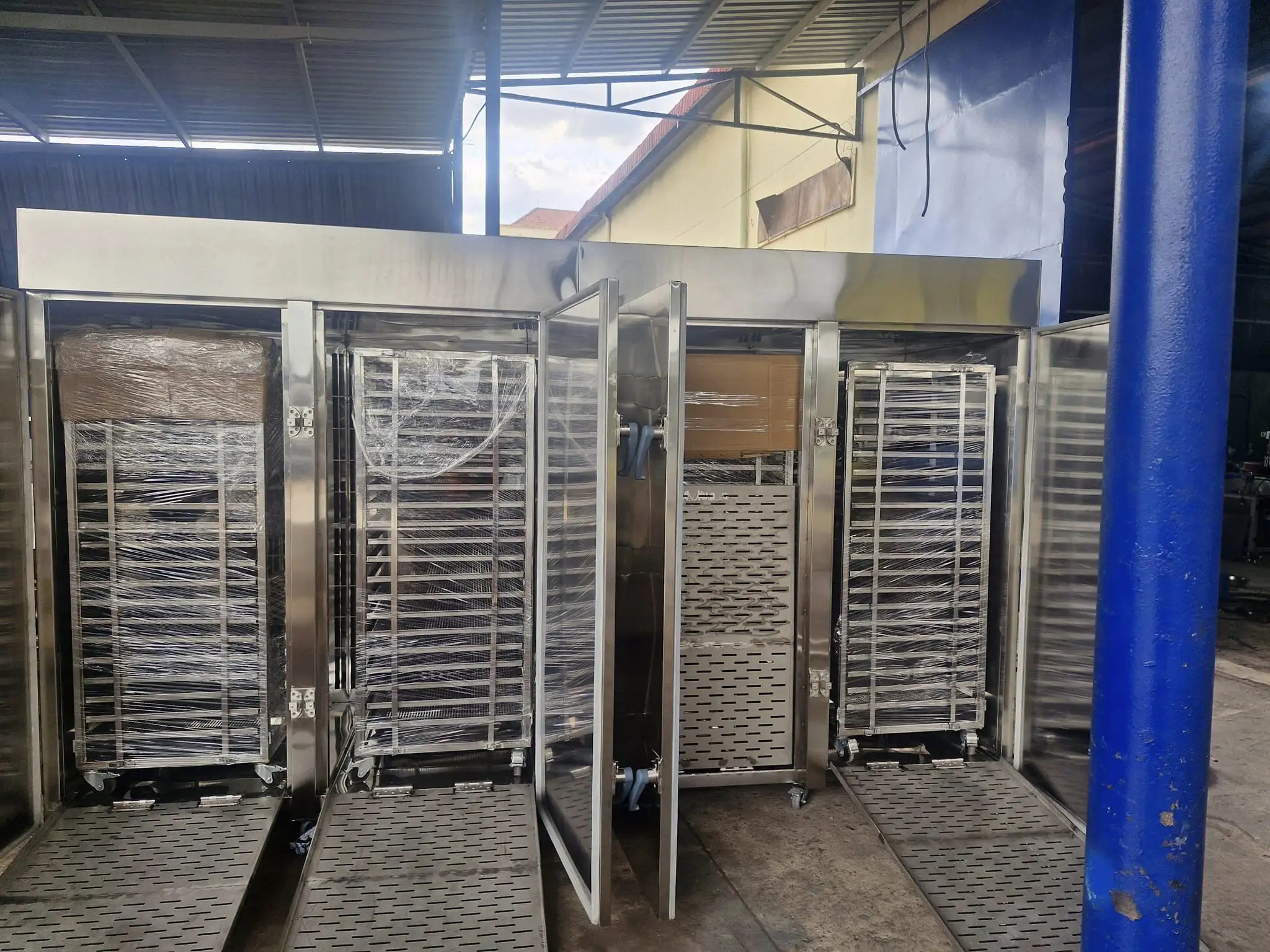
Many entrepreneurs start with small 10-tray dryers. However, once you secure a contract with a supermarket or an export partner, your capacity needs to explode. This is where professional-grade engineering becomes a necessity.
When choosing a machine to lead your production line, you need a balance of massive capacity and intelligent dual-chamber control. For those ready to dominate their market, the
K500 Hot Air Circulating Dryer
represents the pinnacle of this technology, offering the ability to process up to 500kg per batch while maintaining the delicate sensory qualities of the fresh produce.
Investing in high-capacity equipment allows you to normalize your production schedules, reduce labor costs through bulk loading, and ensure that your brand stands for consistent quality.
Expert Advice: 3 Rules for Perfect Drying Results
1. The “Thin and Even” Loading Rule
Never overlap your products on the tray. If pieces are touching, air cannot circulate around the entire surface area. This leads to “clumping” and uneven moisture content, which can cause mold growth during storage.
2. Respect the Pre-Heating Phase
Don’t load your product into a cold machine. Let the dryer reach its target temperature for 15-20 minutes first. This ensures that the moment the food enters, evaporation begins instantly, preventing the growth of spoilage bacteria in a lukewarm environment.
3. Seasonal Humidity Adjustments
The air outside the dryer affects the air inside. On a rainy, humid day, you may need to increase the exhaust vent opening or slightly raise the temperature by 2-3°C to maintain the same drying speed as a dry, sunny day.
Final Thoughts: The Foundation of Modern Food Production
The Hot Air Circulating Dryer is more than just a piece of stainless steel—it is a vital tool for food security and economic growth. It allows farmers to save their harvests from rotting, and it allows manufacturers to create high-value products that can be shipped around the globe.
If you are choosing a dryer today, look beyond the price tag. Look at the thermal insulation density, the PLC’s user interface, and the reputation of the manufacturer. A high-quality dryer will be your most reliable business partner for the next 20 years.
