


I. What is Sublimation Drying?
Sublimation drying is the process of removing water from food by converting it directly from a solid to a gas in a vacuum environment.
Under vacuum conditions, when heat is applied, water sublimates directly from solid (ice) to gas. This ensures that the product retains its original shape, color, flavor, and nutrients after dehydration.
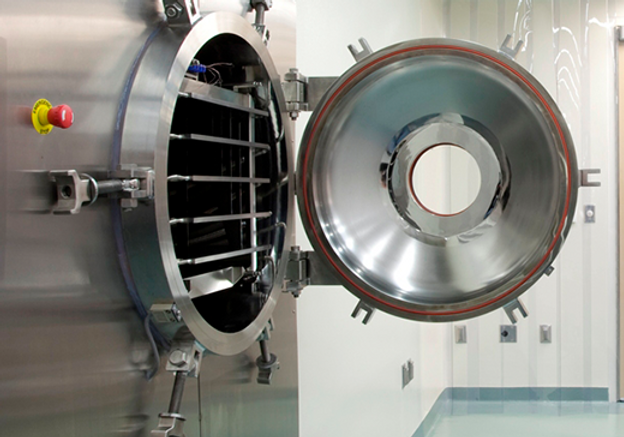
What is Sublimation Drying
At normal temperatures, water in food exists in liquid form. To achieve sublimation, the water must first be converted into a solid state by freezing. Hence, sublimation drying is also known as freeze-dry dehydration.
The technology was first invented by Jacques-Arsene d’Arsonval in 1906. Since then, it has revolutionized food processing and preservation, allowing the industry to break new ground in maintaining food quality over time.
II. How Does Sublimation Drying Work?
Sublimation drying is a sophisticated process. To understand it fully, let’s analyze its working principles step by step.
The process is based on the sublimation principle, where water transitions directly from a solid (ice) to a gaseous state, bypassing the liquid phase.
Here’s how sublimation drying works:
- Freezing Stage:
Food is frozen at temperatures between -10°C to -40°C. Water content turns into ice. - Sublimation Stage:
The frozen food is placed in a vacuum chamber, where precise heat is applied. This causes the ice to sublimate into vapor without melting into liquid. The vapor is then collected, condensed into ice by the cooling system, and expelled. - Secondary Drying:
After most moisture is removed, the remaining water is eliminated, leaving a final moisture content of 1-4%.
To finish the process, nitrogen gas is used to fill the voids left by the removed water, preventing shrinkage or deformation of the food.
III. Sublimation Drying Process
Using this principle, engineers and technicians have developed a systematic process to manufacture dried foods efficiently, described as follows:
- Freezing the Raw Material:
The product is quickly frozen at temperatures between -30°C and -50°C. Once completely frozen, it is transferred to the vacuum chamber. - Sublimation Phase:
- A vacuum pump removes air from the chamber, creating a vacuum environment.
- Heat is carefully applied to sublimate the ice directly into vapor.
- The vapor is absorbed and condensed into ice in the cooling system, then expelled.
At this stage, approximately 90% of the water is removed. Residual moisture is then eliminated during a secondary drying stage to achieve a stable final product.
- Final Stage:
- Gradually increase the temperature inside the chamber to complete the drying process.
- Adjust the final moisture level to between 1% and 4%.
One remarkable feature of sublimation drying is that the food can return to its original state when rehydrated, with the same shape, color, nutritional content, and flavor as before drying.
IV. Applications of Sublimation Drying in Food Production
Sublimation drying is highly effective for preserving food and is widely used in the food processing industry due to its superior ability to maintain the food’s original quality. Some notable applications include:
- Drying Medicinal Herbs:
Sublimation drying is widely used for preserving functional foods such as cordyceps and reishi mushrooms. These products retain their active compounds and natural characteristics after drying. - Preserving Fresh Produce:
This method is perfect for fruits, vegetables, and water-rich foods like kiwi, strawberries, mangoes, and watermelons. These foods maintain their natural taste, texture, and appearance post-drying. - Powdered Food Production:
Sublimation drying is ideal for creating high-quality powders, such as vegetable powders, fish powders, and cocoa powders.
V. Advantages and Disadvantages of Sublimation Drying
1. Advantages of Sublimation Drying:
- Preserves Original Quality:
Foods retain their original shape, color, nutrients, and flavor. - Crisp Texture:
The dried product is light, crisp, and highly appealing. - Versatile:
Suitable for a wide range of foods, including water-rich fruits and large meat cuts.
2. Disadvantages of Sublimation Drying:
- High Costs:
Sublimation dryers are expensive due to their complex design. - Time-Consuming:
A single drying cycle takes significant time, consuming energy and labor. - Maintenance Costs:
Maintenance and consumables like lubricants are relatively costly.
These factors contribute to higher prices for sublimation-dried foods compared to products dried by other methods.
VI. Where to Buy High-Quality Sublimation Dryers?
Sublimation dryers are advanced machines consisting of key components such as the drying chamber, freezing system, heating system, vacuum pump, condensation unit, and electronic control panel.
MILO is a trusted provider with years of experience in designing and installing sublimation drying systems for industrial and small-scale use.
For expert advice and assistance, contact MILO today at 0932 648 979. Address: 54 HT Street 31, Hiep Thanh, District 12, Ho Chi Minh City.
See more: The Difference Between Hot Air Dryers and Sublimation Dryers for Food
